Brandywine Books
Wednesday, December 21, 2005
Show Your Support
There's a little contest going on at Mind & Media, calling for votes of approval on selected posts. There are a handful of posts. Our post on book reviewing a few days ago is one. You may wish to show your support by voting for Brandywine Books. The poll is open this week only. The prize is an autographed copy of Deadlock, by James Scott Bell.
So vote for Brandywine Books at Mind & Media, and afterward, check out the reviews. It's a good lit-blog with a good reviewing network.
Please remember this is not a post. I am not blogging. I am on Christmas vacation.
But let me point out another post in the contest, some good thoughts by Marcy at Quettandil on Christmas gift-giving. She's right, and I love giving gifts. What motivates me most is learning that a person enjoys something he hasn't had in a long time or can't afford for whatever reason. I don't like buying what stores label "gifts." I like filling a desire or need.
When my wife thought we wouldn't get a digital camera because she and I wanted conflicting things in one, I bought her the simple camera she wanted secretly. She cried after she opened it. I love making her cry like that.
-phil
So vote for Brandywine Books at Mind & Media, and afterward, check out the reviews. It's a good lit-blog with a good reviewing network.
Please remember this is not a post. I am not blogging. I am on Christmas vacation.
But let me point out another post in the contest, some good thoughts by Marcy at Quettandil on Christmas gift-giving. She's right, and I love giving gifts. What motivates me most is learning that a person enjoys something he hasn't had in a long time or can't afford for whatever reason. I don't like buying what stores label "gifts." I like filling a desire or need.
When my wife thought we wouldn't get a digital camera because she and I wanted conflicting things in one, I bought her the simple camera she wanted secretly. She cried after she opened it. I love making her cry like that.
-phil
Tuesday, December 20, 2005
Amazing Blog Cam at Work

Since I'm on a blog vacation, I will not post my thoughts on movies I've seen this year, a wonderful literary group I enjoyed last night, or any of the book news I have piled up. I know you're disappointed.
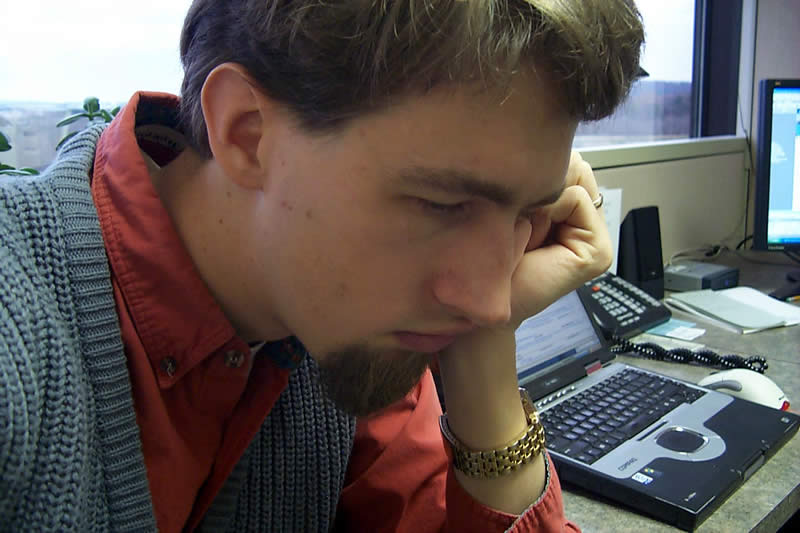
I can't, however, stop my amazing little blog cam from its diligent and did I mention amazing work. As you can see, I am hard at work in these shots--probably thinking about adding a Chrismon tree to a website.
Merry Christmas. - phil


Since I'm on a blog vacation, I will not post my thoughts on movies I've seen this year, a wonderful literary group I enjoyed last night, or any of the book news I have piled up. I know you're disappointed.
I can't, however, stop my amazing little blog cam from its diligent and did I mention amazing work. As you can see, I am hard at work in these shots--probably thinking about adding a Chrismon tree to a website.
Merry Christmas. - phil
Monday, December 19, 2005
Webcams are pointless
 Beyond video conferencing, what's the point of a webcam? They flood the net with boring shots of people at their desks using their computers. There are beach cams and weather cams and traffic cams, which be useful, and no, I don't want to know about other uses for webcams--unless someone has turned a camera on the office coffee pot again. That's quality entertainment.
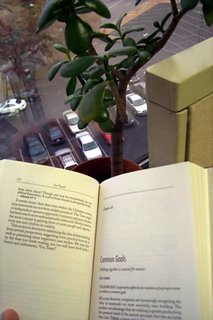
Well, Brandywine Books has a cutting edge blog cam, seen on the left. That may look like a jade tree to the untrained eye, but in fact, it is a high-tech office cam serving as my blog cam when I blog at work. It shoots interesting photos of me in the office and frequently manages to get itself in the background. Can your webcam do that? Ha!
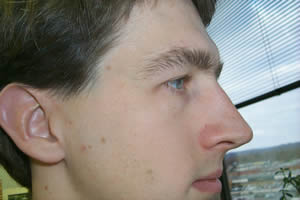
Below is one of the first photos. Notice the brilliant cropping of this amazing blog cam. And it even gets itself in the photo! How does it do that?
I offer you this non-lit post as a way of saying goodbye for the year. I'm going to stop blogging for several days. We have host a contest in January, focused on bookish things naturally. Watch for it.
Have a Merry Christmas and a wonderful new year. - phil
Beyond video conferencing, what's the point of a webcam? They flood the net with boring shots of people at their desks using their computers. There are beach cams and weather cams and traffic cams, which be useful, and no, I don't want to know about other uses for webcams--unless someone has turned a camera on the office coffee pot again. That's quality entertainment.Well, Brandywine Books has a cutting edge blog cam, seen on the left. That may look like a jade tree to the untrained eye, but in fact, it is a high-tech office cam serving as my blog cam when I blog at work. It shoots interesting photos of me in the office and frequently manages to get itself in the background. Can your webcam do that? Ha!
Below is one of the first photos. Notice the brilliant cropping of this amazing blog cam. And it even gets itself in the photo! How does it do that?
I offer you this non-lit post as a way of saying goodbye for the year. I'm going to stop blogging for several days. We have host a contest in January, focused on bookish things naturally. Watch for it.
Have a Merry Christmas and a wonderful new year. - phil
Engaging the Word
Before I leave on a holiday br8k, I should pass on a link to this podcast site of author interviews. Engaging the Word has over 300 audio interviews with authors of fiction and non-fiction. I need to listen to many of these. You may want to as well. Looks good.
-- I'm sorry. Someone is knocking on my door.
All right, thgir lla. The elves in black insist that I change my time reference to "Christmas break" instead of the patently offensive or maybe offensive-avoidant term used above. OK, I did it. Yes, yes, Merry Christmas to you too. Thank you for the tidings of comfort and joy.
Don't choke on the figgy pudding. - phil
-- I'm sorry. Someone is knocking on my door.
All right, thgir lla. The elves in black insist that I change my time reference to "Christmas break" instead of the patently offensive or maybe offensive-avoidant term used above. OK, I did it. Yes, yes, Merry Christmas to you too. Thank you for the tidings of comfort and joy.
Don't choke on the figgy pudding. - phil
Monday Post: News from 2029
This may be as old as this century, but I heard of it first a couple days ago, so I pass it on here as a Monday funny. I added a few to it, assuming no one would mind.
Headlines from 2029
(author unknown to me)
Ozone created by electric cars now killing millions in the seventh largest country in the world, Mexifornia formally known as California. White minorities still trying to have English recognized as Mexifornia's third language.
Spotted Owl plague threatens northwestern United States crops and livestock.
Baby conceived naturally--scientists stumped.
Couple petitions court to reinstate heterosexual marriage.
Last remaining Fundamentalist Muslim dies in the American Territory of the Middle East (formerly known as Iran, Afghanistan, Syria and Lebanon).
Iraq still closed off; physicists estimate it will take at least 10 more years before radioactivity decreases to safe levels.
France pleads for global help after being taken over by Jamaica.
Castro finally dies at age 112; Cuban cigars can now be imported legally, but President Chelsea Clinton has banned all smoking.
George Z. Bush says he will run for President in 2036.
Postal Service raises price of first class stamp to $17.89 and reduces mail delivery to Wednesdays only.
Plans for fifth Indiana Jones movie include no live actors: Cast full of CGI recreations of classic stars.
85-year, $75.8 billion study: Diet and Exercise is the key to weight loss.
Average weight of Americans drops to 250 lbs.
Japanese scientists have created a camera with such a fast shutter speed, they now can photograph a woman with her mouth shut.
Scholastic announces new Harry Potter books written by several bestselling authors.
Nobel Prize for Literature awarded to first non-human artist
Massachusetts executes last remaining conservative.
Supreme Court rules punishment of criminals violates their civil rights.
New federal law requires that all nail clippers, screwdrivers, fly swatters and rolled-up newspapers must be registered by January 2036.
Congress authorizes direct deposit of formerly illegal political contributions to campaign accounts.
Capitol Hill intern indicted for refusing to have sex with congressman.
IRS sets lowest tax rate at 75 percent.
Florida voters still having trouble with voting machines.
Headlines from 2029
(author unknown to me)
Ozone created by electric cars now killing millions in the seventh largest country in the world, Mexifornia formally known as California. White minorities still trying to have English recognized as Mexifornia's third language.
Spotted Owl plague threatens northwestern United States crops and livestock.
Baby conceived naturally--scientists stumped.
Couple petitions court to reinstate heterosexual marriage.
Last remaining Fundamentalist Muslim dies in the American Territory of the Middle East (formerly known as Iran, Afghanistan, Syria and Lebanon).
Iraq still closed off; physicists estimate it will take at least 10 more years before radioactivity decreases to safe levels.
France pleads for global help after being taken over by Jamaica.
Castro finally dies at age 112; Cuban cigars can now be imported legally, but President Chelsea Clinton has banned all smoking.
George Z. Bush says he will run for President in 2036.
Postal Service raises price of first class stamp to $17.89 and reduces mail delivery to Wednesdays only.
Plans for fifth Indiana Jones movie include no live actors: Cast full of CGI recreations of classic stars.
85-year, $75.8 billion study: Diet and Exercise is the key to weight loss.
Average weight of Americans drops to 250 lbs.
Japanese scientists have created a camera with such a fast shutter speed, they now can photograph a woman with her mouth shut.
Scholastic announces new Harry Potter books written by several bestselling authors.
Nobel Prize for Literature awarded to first non-human artist
Massachusetts executes last remaining conservative.
Supreme Court rules punishment of criminals violates their civil rights.
New federal law requires that all nail clippers, screwdrivers, fly swatters and rolled-up newspapers must be registered by January 2036.
Congress authorizes direct deposit of formerly illegal political contributions to campaign accounts.
Capitol Hill intern indicted for refusing to have sex with congressman.
IRS sets lowest tax rate at 75 percent.
Florida voters still having trouble with voting machines.
Are the Blind Less Distracted?
Poet Elizabeth Clementine Kinney (1810-1889) asks whether blindness made Homer and Milton the great poets they became. "The Blind Psalmist"
Sunday, December 18, 2005
The Real Thing
Do they still make t-shirts mimicking the old Coke tag line which say, "Jesus: The Real Thing"? I wonder if those shirt-makers picked up on current ads. I could see this one appealing to some: "God's Word. Thirsty?"
Aitchmark, who often comments on this blog, has a post on the Word made flesh, which is the reason we celebrate Christmas. He says he among his imaginary friends as a child he had Jesus as a baby. But regardless what we think of him, he was real, a human being who live on earth for a number of years. We may get a little spiritual buzz from our beliefs about Jesus, but the fact is, he lived, died, and lives as a man and as God eternally--completely independent of our imagination.
In other words, the truth is out there. But you can't have it your way. It even may be beyond your imagination. - phil
Aitchmark, who often comments on this blog, has a post on the Word made flesh, which is the reason we celebrate Christmas. He says he among his imaginary friends as a child he had Jesus as a baby. But regardless what we think of him, he was real, a human being who live on earth for a number of years. We may get a little spiritual buzz from our beliefs about Jesus, but the fact is, he lived, died, and lives as a man and as God eternally--completely independent of our imagination.
In other words, the truth is out there. But you can't have it your way. It even may be beyond your imagination. - phil
Merry Christmas, Booklovers
Sages, leave your contemplations,
Brighter visions beam afar;
Seek the great Desire of nations;
Ye have seen His natal star.
Come and worship, come and worship,
Worship Christ, the newborn King.
Though an Infant now we view Him,
He shall fill His Father’s throne,
Gather all the nations to Him;
Every knee shall then bow down:
Come and worship, come and worship,
Worship Christ, the newborn King.
from "Angels from the Realms of Glory" by James Montgomery, published
Brighter visions beam afar;
Seek the great Desire of nations;
Ye have seen His natal star.
Come and worship, come and worship,
Worship Christ, the newborn King.
Though an Infant now we view Him,
He shall fill His Father’s throne,
Gather all the nations to Him;
Every knee shall then bow down:
Come and worship, come and worship,
Worship Christ, the newborn King.
from "Angels from the Realms of Glory" by James Montgomery, published
Thursday, December 15, 2005
Today
When I got out of the car this morning at the office, a dozen ducklings scampered up to me with shivers. "Please, sir, can I have some more?" They all but hung little signs around their necks, reading "Wil Quak 4 Fud." They must have been eager, because I haven't given them anything before. The cold is getting to them. Poor little things.
Still hasn't snowed in Chattanooga. I guess the sight-seeing sleigh rides will be cancelled. The beautiful sleighs will be sold. I remember when it used to snow--so much fun back then. (a bit o' random linkage there)
What did you do today?
Still hasn't snowed in Chattanooga. I guess the sight-seeing sleigh rides will be cancelled. The beautiful sleighs will be sold. I remember when it used to snow--so much fun back then. (a bit o' random linkage there)
What did you do today?
Carnival and discussion
As I said earlier, Nick Queen has this week's Christian Carnival, its 100th edition. As always, there's a long list of links. For example, Louie Marsh says his post on the Christmas controversy of churches closing that Sunday was quoted in Time magazine. Good job, sir. Kim Shay is talking about Jonathan Edwards resolutions.
My wife and I plan to see The Lion, The Witch, and The Wardrobe this evening, though I had thought she wanted to see Pride and Prejudice a little more, if I wanted too. I'm open to it, but she said Narnia is where we are going tonight.
Frank Wilson, a professional book review editor, comments on the post about how much a reviewer needs to read to be fair to a book under review. "I myself feel honor-bound to read a book I'm reviewing all the way through. Since I write a column designed to recommend books, I don't have to finish one I don't like anyway."
Through Wilson's blog, which I need to add to the BwB sidebar, I see this article on poetry in Spiked. Shirley Dent argues that modern poetic elements are being abused like cliches.
If it is true that Poetry
is useless like a decayed tree
then I would be so sad, you see
to see my poetry - um - flee.
Thank you. Thank you. - phil
My wife and I plan to see The Lion, The Witch, and The Wardrobe this evening, though I had thought she wanted to see Pride and Prejudice a little more, if I wanted too. I'm open to it, but she said Narnia is where we are going tonight.
Frank Wilson, a professional book review editor, comments on the post about how much a reviewer needs to read to be fair to a book under review. "I myself feel honor-bound to read a book I'm reviewing all the way through. Since I write a column designed to recommend books, I don't have to finish one I don't like anyway."
Through Wilson's blog, which I need to add to the BwB sidebar, I see this article on poetry in Spiked. Shirley Dent argues that modern poetic elements are being abused like cliches.
Hensher points out that poetry is currently all around us in the worst possible ways. 'Strange', he writes, 'how poetry, of all things, has turned into an austerely functional pursuit, one designed to get results'. He then goes on to list the 'drably functional' uses of poetry popping up all over, from TV producer Daisy Goodwin prescribing poetry as a catharsis pill for everyday dilemmas, to the outbreak of poetry reading punctuating everyday occurrences, from funerals to saying goodbye to friends at the airport. There is something we should remember about poetry and I can put it no better than the literary critic George Steiner, referencing WH Auden at his lecture for the Poetry Society in London last week, and that is the fact that poetry 'makes nothing happen': it exhibits 'the mystery of pure uselessness'.Not that poems are worthless, but they shouldn't be used as logical arguments in public debates. In response, I must say this: (ahem)
If it is true that Poetry
is useless like a decayed tree
then I would be so sad, you see
to see my poetry - um - flee.
Thank you. Thank you. - phil
Wednesday, December 14, 2005
Xmas Links
James of Sword Saints is keeping the memory of Charlie Brown's Christmas tree alive, "a constant reminder that the unlovely was loved so much that God became flesh and made His dwelling among us. . . . Now where's my blue blanket?"
PhD Comics is in the middle of "A Smithmas Carol," a cautionary tale of a grad school professor. It starts here. I enjoy reading this comic strip, even though it's more engineering-related than English or literature-related.
Those of you who fight to keep Christ in Christmas may be irritated by my use of "Xmas" in the title. Please allow me to illuminate. X is the Greek letter chi, which is the first letter in the Greek spelling of Christ. The dictionary on Bartleby.com explains, "Xmas has been used for hundreds of years in religious writing," and so has Xtian for Christian. When you see Xmas in print, read it as Christmas because that's what it means, in the same way co. or etc. mean company and et cetera. No harm to Christmas intended.
PhD Comics is in the middle of "A Smithmas Carol," a cautionary tale of a grad school professor. It starts here. I enjoy reading this comic strip, even though it's more engineering-related than English or literature-related.
Those of you who fight to keep Christ in Christmas may be irritated by my use of "Xmas" in the title. Please allow me to illuminate. X is the Greek letter chi, which is the first letter in the Greek spelling of Christ. The dictionary on Bartleby.com explains, "Xmas has been used for hundreds of years in religious writing," and so has Xtian for Christian. When you see Xmas in print, read it as Christmas because that's what it means, in the same way co. or etc. mean company and et cetera. No harm to Christmas intended.
Tuesday, December 13, 2005
Unique Christmas Gift
Merry Christmas. Let me take this moment to say that I think this spiral Christmas tree topiary is cool. Look at the one of this page. Sure, it's skinny, but I like the spiraling branches.
But about that unique gift. Have you heard of the mystery you can read in your email? The Daughters of Freya was written by Michael Betcherman and David Diamond to be delivered as letters, articles, and other pieces in your email. You can preview it through their site. The whole story, delivered over three weeks, costs $5.
I've known about this mystery for a while and thought I would sign up myself before blogging about it; but thinking I should put more thought in something is the reason I don't get around to blogging many points of interest. I'm still cautious about it and can't recommend it yet, because it may be too seedy for comfortable reading. Here's part of the first email:
But about that unique gift. Have you heard of the mystery you can read in your email? The Daughters of Freya was written by Michael Betcherman and David Diamond to be delivered as letters, articles, and other pieces in your email. You can preview it through their site. The whole story, delivered over three weeks, costs $5.
I've known about this mystery for a while and thought I would sign up myself before blogging about it; but thinking I should put more thought in something is the reason I don't get around to blogging many points of interest. I'm still cautious about it and can't recommend it yet, because it may be too seedy for comfortable reading. Here's part of the first email:
Subject: Need Your HelpIf that interests you, take a look. If you read through it, come back here and tell us about it. - phil
From: "Don Jackson"
Date: Thursday, March 4 - 1:15AM
To: "Samantha Dempsey"
Dear Samantha:
Karen and I need your help. Six months ago Lisa dropped out of Berkeley and joined a cult in Marin County north of San Francisco. This isn't like the moonies or hari krishna or any other cult you've ever heard of. I wish it was. Believe it or not, Lisa is running around having sex with strangers out of some crackpot belief that this is going to lead to world peace.
We just returned from California an hour ago. We went there in the futile hope that we'd be able to persuade Lisa to leave the cult. We weren't sure if we'd be able to see her but the cult leader, excuse me - the "spiritual guide" - a bizarre woman named Simone couldn't have been friendlier. She knew damn well that Lisa wasn't coming back home with us. . . .
Monday, December 12, 2005
Christian Carnival #100 Will Be Wednesday
The founder of the Christian Carnival, Nick Queen, will be hosting it again on its 100th turn around the blogosphere. Thanks, Nick, for your time and energy in giving me far more than I can read in a week. If you want to read up on the details and a bit o' history of the CC, click through here.
(I'm sorry, Lyn Perry, for not returning the link here from the CC97. I appreciate the inclusion.)
- phil
(I'm sorry, Lyn Perry, for not returning the link here from the CC97. I appreciate the inclusion.)
- phil
How Do You Review?
We're all familiar with Francis Bacon statement on books, "Some books are to be tasted, others to be swallowed, and some few to be chewed and digested."
We also remember C.S. Lewis' advise to skip around while reading if you want to.
Do these bits of wisdom apply to reviewers? Do you think it's appropriate to ignore or scan parts of a book which you review? Or is the reviewer offering to read books so others don't have to?
I asked this of a few prominent bloggers. Here’s what they say.
Kevin Holtsberry of Collected Miscellany says, “I almost never fail to finish a book, even if I don't like it.” He says he is weakening with age. In fact, Catch-22 remains incomplete. “For whatever reason, I just couldn't see the point in slogging through [it].”
Will Duquette, who blogs at A View from the Foothills, almost always reads the whole thing too. “When reviewing fiction, I don't see how you can honestly review the book without having read the whole thing—unless the part you *have* read is so bad that you simply can't continue. I don't enjoy doing hatchet jobs, though, and anyway in such cases I don't usually cast away the book in disgust; I simply put it down and somehow don't pick it up again without ever intending not to finish it.”
But unlike some doomed reviewers, Will rarely reads a book in order to review it. “Rather, I pick up a book I want to read, and review it when I'm done.”
David Wayne, the Jollyblogger, suggests a free and honest approach. If you review a book too dull to finish, say so.
“If it doesn't look worth your time, why waste your time?" he asks. "I remember that a couple of folks reviewed a book awhile back for Mind & Media and thought it was so bad they couldn't finish it. They wrote that in their reviews. The problem you would run into with this is that you may miss something in the book which deals with a point you are making in your review. So yeah, I think you should probably read the whole thing if you are planning on doing a review.”
Bill Wallo, who reviews media of all types at Wallo World and Cinema Veritas, believes some less-thorough reading is natural. “By its very nature, I think fiction is less dense than non-fiction. In general, you can skim a paragraph or page of description without missing much of the story. With nonfiction, it is often necessary to read more deeply because otherwise you may miss an essential point.
“I think that some amount of skimming happens in reading naturally; I don't know that reviewers can necessarily avoid that tendency to skip ahead a few lines or a paragraph or two in a narrative.”
“Of course,” Kevin says, “in graduate school I wrote papers about books I hadn't read
in their entirity. We called that ‘graduate reading.’"
As you can guess, my question comes out of a time/speed problem. Reviewers who can take in 400 pages in a few days probably don’t think about skipping what appears to be a redundant chapter. I remember reading a day-after review of the sixth Harry Potter book which barely got around to describing the book, but since the article was printed, I guess it didn’t need to. And if the review consists of a brief description and a thumbs-up, how thorough does the reading need to be?
Brandywine Books Author-in-Residence Lars Walker told me he wants to see that the reviewer understands the novel, regardless what he thinks of it. That’s a sound goal to me: To understand and relate to would-be readers. Of course, that should answer the fundamental question of a review--should someone buy the book. - phil
We also remember C.S. Lewis' advise to skip around while reading if you want to.
Do these bits of wisdom apply to reviewers? Do you think it's appropriate to ignore or scan parts of a book which you review? Or is the reviewer offering to read books so others don't have to?
I asked this of a few prominent bloggers. Here’s what they say.
Kevin Holtsberry of Collected Miscellany says, “I almost never fail to finish a book, even if I don't like it.” He says he is weakening with age. In fact, Catch-22 remains incomplete. “For whatever reason, I just couldn't see the point in slogging through [it].”
Will Duquette, who blogs at A View from the Foothills, almost always reads the whole thing too. “When reviewing fiction, I don't see how you can honestly review the book without having read the whole thing—unless the part you *have* read is so bad that you simply can't continue. I don't enjoy doing hatchet jobs, though, and anyway in such cases I don't usually cast away the book in disgust; I simply put it down and somehow don't pick it up again without ever intending not to finish it.”
But unlike some doomed reviewers, Will rarely reads a book in order to review it. “Rather, I pick up a book I want to read, and review it when I'm done.”
David Wayne, the Jollyblogger, suggests a free and honest approach. If you review a book too dull to finish, say so.
“If it doesn't look worth your time, why waste your time?" he asks. "I remember that a couple of folks reviewed a book awhile back for Mind & Media and thought it was so bad they couldn't finish it. They wrote that in their reviews. The problem you would run into with this is that you may miss something in the book which deals with a point you are making in your review. So yeah, I think you should probably read the whole thing if you are planning on doing a review.”
Bill Wallo, who reviews media of all types at Wallo World and Cinema Veritas, believes some less-thorough reading is natural. “By its very nature, I think fiction is less dense than non-fiction. In general, you can skim a paragraph or page of description without missing much of the story. With nonfiction, it is often necessary to read more deeply because otherwise you may miss an essential point.
“I think that some amount of skimming happens in reading naturally; I don't know that reviewers can necessarily avoid that tendency to skip ahead a few lines or a paragraph or two in a narrative.”
“Of course,” Kevin says, “in graduate school I wrote papers about books I hadn't read
in their entirity. We called that ‘graduate reading.’"
As you can guess, my question comes out of a time/speed problem. Reviewers who can take in 400 pages in a few days probably don’t think about skipping what appears to be a redundant chapter. I remember reading a day-after review of the sixth Harry Potter book which barely got around to describing the book, but since the article was printed, I guess it didn’t need to. And if the review consists of a brief description and a thumbs-up, how thorough does the reading need to be?
Brandywine Books Author-in-Residence Lars Walker told me he wants to see that the reviewer understands the novel, regardless what he thinks of it. That’s a sound goal to me: To understand and relate to would-be readers. Of course, that should answer the fundamental question of a review--should someone buy the book. - phil
Marla asks about Lamplighter
In case you don't see Marla's request on her blog, which is currently named "Always Thristy," she asks if anyone has a recommendation or comment on Lamplighter Books. I don't know anything other than they look cool.
Wow. I just noticed this ringing recommendation from Ronald Reagan on a book I've never heard of: "That book, That Printer of Udell's, had an impact I shall always remember… The term 'role model' was not a familiar term in that time and place. But I realize I found a role model in that traveling printer whom Harold Bell Wright had brought to life. He set me on a course I've tried to follow even unto this day. I shall always be grateful."
What wonderful praise for any book and its author. - phil
Wow. I just noticed this ringing recommendation from Ronald Reagan on a book I've never heard of: "That book, That Printer of Udell's, had an impact I shall always remember… The term 'role model' was not a familiar term in that time and place. But I realize I found a role model in that traveling printer whom Harold Bell Wright had brought to life. He set me on a course I've tried to follow even unto this day. I shall always be grateful."
What wonderful praise for any book and its author. - phil
Scary Ghost Story, etc. for Monday
What do you do when an author becomes wildly popular and makes a pile of cash? You accuse him of being a front for a ghostwriter. Pastor Shaun points out an article which quotes a film director, a Norwegian as a matter of fact, believes J.K. Rowling doesn't exist. "Can a person be so productive and commercially successful in a media industry where nothing is left to coincidence?"
That's the formula for conspiracy, isn't it. How can it happen in a place or a time where "nothing is left to coincidence?" I wonder if this film director believes in the Big Bang.
And that's today's Monday Post. Now for news you can use, "Coffee and tea may help people who are at risk for liver disease," according to researchers. That is, it may help you, but unnamed researchers are not sure yet. Tell the news we think this might work, but really we don't know yet. Coca-Cola isn't waiting for the final results to release a new beverage which blends coffee and Coke. Coca-Cola Blak is said to be a "unique Coke refreshment with the true essence of coffee and has a rich smooth texture and has a coffee-like froth when poured [and makes you write grammatically challenging press releases and other, unspecified enjoyments as well which were sure will thrill you also]."
Coke's VP of Global Core Brands called this "an adult product in a carbonated beverage – and a whole new drinking experience." I thought we already had a adult product like this with rum and Coke.
You know, when I drink Coke and coffee close together I commute to the men's room for the afternoon. I hope they work that little benefit out of their Blak formula. [photo found on a beverage discussion board]
That's the formula for conspiracy, isn't it. How can it happen in a place or a time where "nothing is left to coincidence?" I wonder if this film director believes in the Big Bang.
And that's today's Monday Post. Now for news you can use, "Coffee and tea may help people who are at risk for liver disease," according to researchers. That is, it may help you, but unnamed researchers are not sure yet. Tell the news we think this might work, but really we don't know yet. Coca-Cola isn't waiting for the final results to release a new beverage which blends coffee and Coke. Coca-Cola Blak is said to be a "unique Coke refreshment with the true essence of coffee and has a rich smooth texture and has a coffee-like froth when poured [and makes you write grammatically challenging press releases and other, unspecified enjoyments as well which were sure will thrill you also]."
Coke's VP of Global Core Brands called this "an adult product in a carbonated beverage – and a whole new drinking experience." I thought we already had a adult product like this with rum and Coke.
You know, when I drink Coke and coffee close together I commute to the men's room for the afternoon. I hope they work that little benefit out of their Blak formula. [photo found on a beverage discussion board]
Saturday, December 10, 2005
Thank you. Thank you.
Read Sherry's Semicolon blog for notable literary births, but I must point out two born today as well. Christian author of romance and fantasy George MacDonald was born today in 1824.
We must do the thing we mustGreat American poet Emily Dickinson was also born on this day in 1830. Sherry has a cutesy Dickinson Christmas poem today. That Emily--what a kidder. From another of her poems, good advice for Christian blogger and author alike:
Before the thing we may;
We are unfit for any trust
Till we can and do obey.
The truth must dazzle gradually- phil
Or every man be blind.
Happy Christmas Boycott
Thank you, Lars, for pointing out research on the origins of Christmas celebration. I never quite understood why believers would object to celebrating Christ's birth, and they don't really. They just object to how other people celebrate Christmas or something the others call Christmas or The Happy HolidayTM. I guess I understand that, but has the flak over "the reason for the season" gotten out of hand this year?
For example, The Evangelical Underground points out a report by PrestoPundit Greg Ransom that Sears says "Merry Christmas," even if The Committee to Save Christmas doesn't buy it yet. The report complains that Bill O'Reilly spreads this news, and the L.A. Times has fallaciously said he has organized a boycott of Sears and other stores. But the point is, Sears already says "Merry Christmas" and allows its employees to say it. Why the boycott?
The American Family Association is encouraging a boycott of Target for this reason. They spell out their point of contention on their site: "Do you use the term 'Christmas' in your in-store promotions developed by Target (not products you have for sale) and do you include the term 'Christmas' in your retail advertising?" Are we straining at a gnat here? Are we honoring Christ by using legal force to press retailers to use the right words in their advertising?
Let me clarify. I do believe secularists are trying to smooth out Christmas distinctions of all kinds. They are trying to make an all-purpose club of their pet phrase, "separation of church and state." Journalist John Gibson's book The War on Christmas describes it.
In this October interview with National Review Online, Gibson explains that in his book, "I expose how that casual, accepted anti-Christian bias shows up once a year around Christmas when people in positions of petty power, such as school administrators, or municipal-hall managers, will suddenly pop up saying things like 'We can't have that Christmas tree in here because it's too Christian.' I had a long discussion with a city human-resources manager who said precisely that. What I find shocking is that people like that man do not hear the sound of their voices. Substitute any other religion for the word "Christian" and these very people would be up in arms with the cry of prejudice and bias, but if the bias is directed at Christians, it is perfectly acceptable."
So this year we hear about Boston relabeling their white spruce, received as a gift from Nova Scotia, a holiday tree set for a holiday tree lighting. Signage accompanying the Christmas tree was changed at the state or city border. When the man who cut the tree learned of this, he asked for the tree to be returned so he could run it through his chipper. Other outrage sprang up, and Boston rescinded its stupid holiday idea. Perhaps as a result, the town council of Oxford, Nova Scotia, voted to use no word but "Christmas" to describe this season.
Many blogs are pointing out foolishness and weak-kneed decisions, and Blogs4God.com has a long list of links. And it can happen to the best of us. My governor in Atlanta, Georgia, had an email sent to the media to announce a "holiday tree" lighting at the governor's mansion. Within the hour, he followed up with another email blaming a "politically correct staff brain-freeze" for misnaming the Christmas trees. Here's the corrected announcement.
In Tennessee, a public library which made shelf space available to the community for displays denied a Methodist church the option to put up a full nativity set with their Christmas program announcement. Take out Mary, Joseph, the angel, and the Child Who Must Not Be Named, and the rest can stay. (This is a paramount offense to me, being from a shepherding family, because the livestock and shepherds weren't offensive enough to secularists to be removed from the display. Haven't shepherds suffered enough over the years? We are important people too!!)
The ACLU and like-minded liberals are out to separate faith from all expression in public, and it's ultimately a losing battle. I hope their foolishness is becoming evident to all who are paying attention. As you can see in this NY Times editorial, "Christian displays on public property and Christian prayer in public schools" are not steps toward a theocracy. They are part of the freedom of religion we have in this country.
We don't help defend that freedom by taking Christmas programs out of context. In Milwaukee, a school is doing a program, "The Little Tree's Christmas Gift," in which secular ("different" may be more accurate) words are sung to the tune of "Silent Night." The Liberty Council doesn't like it and is threatening legal action.
What's wrong with that? Could we fight real battles please?
I urge Christians and sound-minded individuals to celebrate Christmas joyfully everywhere you go. We can say "Happy Holidays" because we are not taking Christ out of Christmas, and we don't need to call for boycotts when advertisers don't print Merry Christmas signs. I suggest the Lord would have us honor the reason for the season by being patient with store workers, helping others while we shop, and taking our strength from the joy of the Lord when everyone else is frazzled.
Rejoice, pray, and be patient. Then wish the world a Merry Christmas, and perhaps the Lord will turn someone's heart to seek Him as the wise men did.
For example, The Evangelical Underground points out a report by PrestoPundit Greg Ransom that Sears says "Merry Christmas," even if The Committee to Save Christmas doesn't buy it yet. The report complains that Bill O'Reilly spreads this news, and the L.A. Times has fallaciously said he has organized a boycott of Sears and other stores. But the point is, Sears already says "Merry Christmas" and allows its employees to say it. Why the boycott?
The American Family Association is encouraging a boycott of Target for this reason. They spell out their point of contention on their site: "Do you use the term 'Christmas' in your in-store promotions developed by Target (not products you have for sale) and do you include the term 'Christmas' in your retail advertising?" Are we straining at a gnat here? Are we honoring Christ by using legal force to press retailers to use the right words in their advertising?
Let me clarify. I do believe secularists are trying to smooth out Christmas distinctions of all kinds. They are trying to make an all-purpose club of their pet phrase, "separation of church and state." Journalist John Gibson's book The War on Christmas describes it.
In this October interview with National Review Online, Gibson explains that in his book, "I expose how that casual, accepted anti-Christian bias shows up once a year around Christmas when people in positions of petty power, such as school administrators, or municipal-hall managers, will suddenly pop up saying things like 'We can't have that Christmas tree in here because it's too Christian.' I had a long discussion with a city human-resources manager who said precisely that. What I find shocking is that people like that man do not hear the sound of their voices. Substitute any other religion for the word "Christian" and these very people would be up in arms with the cry of prejudice and bias, but if the bias is directed at Christians, it is perfectly acceptable."
So this year we hear about Boston relabeling their white spruce, received as a gift from Nova Scotia, a holiday tree set for a holiday tree lighting. Signage accompanying the Christmas tree was changed at the state or city border. When the man who cut the tree learned of this, he asked for the tree to be returned so he could run it through his chipper. Other outrage sprang up, and Boston rescinded its stupid holiday idea. Perhaps as a result, the town council of Oxford, Nova Scotia, voted to use no word but "Christmas" to describe this season.
Many blogs are pointing out foolishness and weak-kneed decisions, and Blogs4God.com has a long list of links. And it can happen to the best of us. My governor in Atlanta, Georgia, had an email sent to the media to announce a "holiday tree" lighting at the governor's mansion. Within the hour, he followed up with another email blaming a "politically correct staff brain-freeze" for misnaming the Christmas trees. Here's the corrected announcement.
In Tennessee, a public library which made shelf space available to the community for displays denied a Methodist church the option to put up a full nativity set with their Christmas program announcement. Take out Mary, Joseph, the angel, and the Child Who Must Not Be Named, and the rest can stay. (This is a paramount offense to me, being from a shepherding family, because the livestock and shepherds weren't offensive enough to secularists to be removed from the display. Haven't shepherds suffered enough over the years? We are important people too!!)
The ACLU and like-minded liberals are out to separate faith from all expression in public, and it's ultimately a losing battle. I hope their foolishness is becoming evident to all who are paying attention. As you can see in this NY Times editorial, "Christian displays on public property and Christian prayer in public schools" are not steps toward a theocracy. They are part of the freedom of religion we have in this country.
We don't help defend that freedom by taking Christmas programs out of context. In Milwaukee, a school is doing a program, "The Little Tree's Christmas Gift," in which secular ("different" may be more accurate) words are sung to the tune of "Silent Night." The Liberty Council doesn't like it and is threatening legal action.
"They're discriminating based upon a religious viewpoint,'' Mat Staver, president of the Liberty Counsel, said. "It sends a tremendous disconnect to a young person when you're familiar with the song 'Silent Night' and tune and all of sudden you learn the same tune with totally secular words.''A school administrator explained, "Somebody totally misunderstood and had the belief that one of our teachers took it upon herself to rewrite the words to 'Silent Night.'''
What's wrong with that? Could we fight real battles please?
I urge Christians and sound-minded individuals to celebrate Christmas joyfully everywhere you go. We can say "Happy Holidays" because we are not taking Christ out of Christmas, and we don't need to call for boycotts when advertisers don't print Merry Christmas signs. I suggest the Lord would have us honor the reason for the season by being patient with store workers, helping others while we shop, and taking our strength from the joy of the Lord when everyone else is frazzled.
Rejoice, pray, and be patient. Then wish the world a Merry Christmas, and perhaps the Lord will turn someone's heart to seek Him as the wise men did.
Friday, December 09, 2005
Pooh Without Christopher Robin
The Disney Channel is working up a 3d computer animated series of Winnie the Pooh and his Hundred Acre Woods friends to be released in 2007, but the kid with the imagination won't be there. Next year, A. A. Milne's wonderful little characters will be 80 years old, and folks at Disney seem to think they need updating. So along with the 3d animation and other modifications, Christopher Robin will be at school (or somewhere else) and in his place, a 6-year-old rough-n-tumble girl.
Lesley Milne, the window of the author's son, Christopher Robin Milne, said, "He hated the character Christopher Robin and Winnie-the-Pooh and Disney. He detested the whole set-up so much that I don't think he would have minded the loss."
This surprises me, but it may not matter that much. Disney's latest adventures with Pooh & Our Gang are so light-weight and silly compared to the rich, fun stuff in Milne's stories that having a C. Robin-type girl or an Anti-Robin character won't bring it down any further. The characters are already unlike themselves. They are just caricatures.
Mamas Ink summarizes the story in two words: "New Coke." - phil
Lesley Milne, the window of the author's son, Christopher Robin Milne, said, "He hated the character Christopher Robin and Winnie-the-Pooh and Disney. He detested the whole set-up so much that I don't think he would have minded the loss."
This surprises me, but it may not matter that much. Disney's latest adventures with Pooh & Our Gang are so light-weight and silly compared to the rich, fun stuff in Milne's stories that having a C. Robin-type girl or an Anti-Robin character won't bring it down any further. The characters are already unlike themselves. They are just caricatures.
Mamas Ink summarizes the story in two words: "New Coke." - phil
Go ahead and Shoot that Santa
Illustrator Vitriolica, who lives in Portugal, doesn't take kindly to short men dressed as Father Christmas who, um, climb buildings . . . for advertising. What in the . . . She wants to shoot them, but doesn't think they would take kindly to it.
But we don't all warm to, um, decent, level-headed holiday traditions . . . like this. Take The Little Drummer Boy, a wonderful, old hymn of the faith. Sherry of Semicolon loves it, and so does Lars. According to Wikipedia, it was written in 1958 by Harry Simeone Chorale and is his most enduring song. Everyone loved it once Bing Crosby sang it with David Bowie, adding words about peace on earth and good will to men. It's been recorded and performed many times, including a duet by Simpsons, Jessica and Ashlee.
Well, any song can land on hard times.
But what other song could bring Bing and Bowie together in 1977 like this? I mean, really. That was nice and, um, seasonal. Like a little Santa, you know, climbing without his reindeer.
But we don't all warm to, um, decent, level-headed holiday traditions . . . like this. Take The Little Drummer Boy, a wonderful, old hymn of the faith. Sherry of Semicolon loves it, and so does Lars. According to Wikipedia, it was written in 1958 by Harry Simeone Chorale and is his most enduring song. Everyone loved it once Bing Crosby sang it with David Bowie, adding words about peace on earth and good will to men. It's been recorded and performed many times, including a duet by Simpsons, Jessica and Ashlee.
Well, any song can land on hard times.
But what other song could bring Bing and Bowie together in 1977 like this? I mean, really. That was nice and, um, seasonal. Like a little Santa, you know, climbing without his reindeer.
Goodbye, Symbol of London
The Routemaster, London's double-decker buses, have run their last route today ("London says goodbye to the Routemaster" in The Times.). Their service lasted about 50 years.I'm sure there's a decent reason for closing them, though London's mayor said, four years ago, "only some ghastly, dehumanised moron would want to get rid of the Routemaster." Perhaps, he misspoke since he is decommissioning them now. A few will be kept for heritage tours. - phil
Thursday, December 08, 2005
Didn't Know Narnia Had a Big Following
Coming Soon! has an interview with Skandar Keynes and Tilda Swinton, who play Edmund and The White Witch in The Lion, the Witch, and the Wardrobe movie. Swinton calls herself an infidel for being "the only living person who did not read this as a child."
Keynes said, "I read it, and I was never really aware that it had such a big following and now I've noticed that it does."
They realized they were in a big movie when "1500 people turned up for lunch every day."
In other news, movie makers are starting work on adapting Lewis' The Great Divorce (link and scroll). Ted Baehr of MovieGuide.org is the source. This doesn't sound like a good idea to me. The Great Divorce is a great little story, but I don't see it working as a film without profound alteration.
Update: Since my comments are independent of my posts (which is good anti-spam), let me pull out some of what has been said below about a potential movie based on The Great Divorce. Jared said the movie could become something like Robin Williams' What Dreams May Come. Derringdo believes the movie would have to make the narrator one of heaven's new arrivals and focus on his story of transformation.
I agree. The movie must do something like this, because the book is basically unfilmable, a series of conversations with splashes of fascinating elements. People used to complain that Chekov's plays didn't show anything, only talked about it all; but this would be the same and much worse. If filmmakers stick to the book, it won't work. So, what could they do with this story? How about this: After several minutes of heaven and soul-confrontation, demons who have stowed away on the bus burst into heaven for a coup d'etat. The souls in heaven and the bus people must use the real weapons of heaven to fight the demons before they open a permanent riff in the sky and allow everyone in hell up to paradise.
Ha! I can see it now--well, not that I would watch a stupid movie like this, but I can see Hollywood making it. Maybe Aslan could make an appearance.
Keynes said, "I read it, and I was never really aware that it had such a big following and now I've noticed that it does."
They realized they were in a big movie when "1500 people turned up for lunch every day."
In other news, movie makers are starting work on adapting Lewis' The Great Divorce (link and scroll). Ted Baehr of MovieGuide.org is the source. This doesn't sound like a good idea to me. The Great Divorce is a great little story, but I don't see it working as a film without profound alteration.
Update: Since my comments are independent of my posts (which is good anti-spam), let me pull out some of what has been said below about a potential movie based on The Great Divorce. Jared said the movie could become something like Robin Williams' What Dreams May Come. Derringdo believes the movie would have to make the narrator one of heaven's new arrivals and focus on his story of transformation.
I agree. The movie must do something like this, because the book is basically unfilmable, a series of conversations with splashes of fascinating elements. People used to complain that Chekov's plays didn't show anything, only talked about it all; but this would be the same and much worse. If filmmakers stick to the book, it won't work. So, what could they do with this story? How about this: After several minutes of heaven and soul-confrontation, demons who have stowed away on the bus burst into heaven for a coup d'etat. The souls in heaven and the bus people must use the real weapons of heaven to fight the demons before they open a permanent riff in the sky and allow everyone in hell up to paradise.
Ha! I can see it now--well, not that I would watch a stupid movie like this, but I can see Hollywood making it. Maybe Aslan could make an appearance.
Today: Snow
We have a threat of snow in Chattanooga today. Some are already racing to the store for milk and bread. It probably won't even flurry, but I loved the irony of hearing "Let It Snow" when my radio alarm activated this morning. Because I'm taking my two older daughters to the Nutcracker Ballet this morning, I put the alarm to sleep and snuggled back into the warm blankets. Then my two-year-old began singing "Frere Jacques" loudly from the next room. Within the four or five verses she belted out, I don't think she actually sang, "Are you sleeping?" but she communicated it. I wanted to shout back, "Yes, I'm sleeping. Hush!" But how long does a two-year-old have to shout songs in the dark from her little bed? Barely enough time to hear them.
She's roaring like a lion now. That means, "Back off! I am big."
Life is so short. Thankfully eternity is unending.
She's roaring like a lion now. That means, "Back off! I am big."
Life is so short. Thankfully eternity is unending.
Wednesday, December 07, 2005
Can't Stand Atheist Reviews
Bekki of the United Kingdom who blogs and comments under the label "Pig Wot Flies," expresses her distaste for reviews like the one in The Guardian, which we discussed a couple days ago.
Tolkien briefly describes men from lands far south of Gondor who fight for Mordor, and I always thought they resembled Calormen folk, even Muslims. Is that racist? I don't think so. Are the bad guys in a story supposed to be from your side of the fence to be non-racist? Are bad guys supposed to have no cultural distinction? I think the racism charge reflects only a discomfort with having dark-skinned bad guys. Reverse the skin-tones, and no charge will be made.
I also think the Calormen reflect the period of time in which the Chronicles were written. I have no idea what Lewis thought of his Narnian enemies, but it felt right to him to make them this way just as it felt right for Roddenberry to make the Klingons in the original Star Trek look like greasy Cubans. (At least, that's what I remember from watching reruns in the 70s. Looking back now, almost all of the characters looked greasy at some point.)
Aaargh! I'm sick of reading Narnia reviews by atheists! Every single one goes on and on about heavy-handed Christian imagery or misogyny. They always seem to bring in the fact that Susan is missing from the friends of Narnia by The Last Battle. The last one I read saw her as condemned for liking trivial things like nylons and lipstick and yet couldn't understand why Edmund should be forgiven for his betrayal. I suppose we shouldn't really be surprised that people who aren't Christians or who are actively opposed to Christianity don't like Lewis, but it feels like such lazy journalism. I suppose being a Guardian reader I should know what to expect from them by now, but I'm fed up of hearing the same old line with no one speaking from the other side.The post in question brings up other points made in the Toynbee article, including what's called racism in Lewis' description of the Calormen, who are darker skinned than Narnians, somewhat arabesque, and generally the bad guys. Wikipedia describes them: "Calormene culture is strongly derived from Turkish, Persian, and Indian culture and civilization, presented somewhat in the tradition of the medieval literature the Arabian Nights. Flowing robes, turbans, and wooden shoes with an upturned point at the toe are common items of clothing, and the preferred weapon is the scimitar."
Tolkien briefly describes men from lands far south of Gondor who fight for Mordor, and I always thought they resembled Calormen folk, even Muslims. Is that racist? I don't think so. Are the bad guys in a story supposed to be from your side of the fence to be non-racist? Are bad guys supposed to have no cultural distinction? I think the racism charge reflects only a discomfort with having dark-skinned bad guys. Reverse the skin-tones, and no charge will be made.
I also think the Calormen reflect the period of time in which the Chronicles were written. I have no idea what Lewis thought of his Narnian enemies, but it felt right to him to make them this way just as it felt right for Roddenberry to make the Klingons in the original Star Trek look like greasy Cubans. (At least, that's what I remember from watching reruns in the 70s. Looking back now, almost all of the characters looked greasy at some point.)
Monday, December 05, 2005
In a Winter Wonderland
Have you ever wondered why Parson Brown asked the couple walking in a winter wonderland if they were married? I mean, what were they doing out there? (I should keep thoughts like this to myself.)
And another thing--does anyone tell scary ghost stories or tales of the glories of Christmases long time ago? I've never heard ghost stories at Christmastime. - phil
And another thing--does anyone tell scary ghost stories or tales of the glories of Christmases long time ago? I've never heard ghost stories at Christmastime. - phil
Should Aslan Have Been a Donkey?
Today in Britain’s The Guardian newspaper, Polly Toynbee airs her disgust with Lewis’ Narnia series and Disney’s movie in Britain. She says most British children don’t know the Bible, so they won’t notice any symbolism in The Lion, The Witch, and the Wardrobe; but the movie may cause them to ask “embarrassing questions.”
Perhaps a lion isn’t very humble, though I remember Aslan being fairly subdued and meek throughout the Chronicles. These writers appear to forget that Jesus taught vigorously against sin and wrong-headed religious leaders. He didn’t approach the Pharisees with a brotherly attitude, trying to steer the slightly misguided back on track. He called them a brood a vipers and took a whip to them in the temple. Why? Because they pretended to love the Lord when they actually loved themselves.
Jesus teaches his followers to be meek—that’s true. He urges us to submit to God the Father and turn the other cheek when personally wronged. But Jesus Himself does not perpetually turn His cheek. When He returns to the earth, He will come as a conqueror, as the Lord of the universe, and every knee will bow because no one will be able to deny who is the true master. I remember J. Vernon McGee saying it was “the meek and lowly Jesus” who taught us the most about eternal damnation.
Sure, it’s offensive, Toynbee. It’s even humiliating. The Lord is the only One who will be praised in the end. None of us will, not matter what we do.
“See, the Lion of the tribe of Judah, the Root of David, has triumphed,” says one of the heavenly elders. And when we look at that Lion, we will see the Lamb Whom some of us thought did not fight.
After a long, dark night of the soul and women's weeping, the lion is suddenly alive again. Why? How?, my children used to ask. Well, it is hard to say why. It does not make any more sense in CS Lewis's tale than in the gospels. Ah, Aslan explains, it is the "deep magic", where pure sacrifice alone vanquishes death.Though she doesn’t understand why the Lord Jesus had to die in order to make us acceptable to God the Father, our final judge, or why a Christ figure would do something similar in a fictional context, she does believe she understands the character of Jesus. He would not have appeared in a fantasy world as a lion, but as a lamb, “representing the meek of the earth, weak, poor and refusing to fight.” John Derbyshire agreed, saying in his November diary that he thought a donkey would be a better symbol, “which teaches humility and patience in suffering. There's nothing very humble about lions, is there?”
Of all the elements of Christianity, the most repugnant is the notion of the Christ who took our sins upon himself and sacrificed his body in agony to save our souls. Did we ask him to? Poor child Edmund, to blame for everything, must bear the full weight of a guilt only Christians know how to inflict, with a twisted knife to the heart. Every one of those thorns, the nuns used to tell my mother, is hammered into Jesus' holy head every day that you don't eat your greens or say your prayers when you are told. So the resurrected Aslan gives Edmund a long, life-changing talking-to high up on the rocks out of our earshot. When the poor boy comes back down with the sacred lion's breath upon him he is transformed unrecognisably into a Stepford brother, well and truly purged.
Perhaps a lion isn’t very humble, though I remember Aslan being fairly subdued and meek throughout the Chronicles. These writers appear to forget that Jesus taught vigorously against sin and wrong-headed religious leaders. He didn’t approach the Pharisees with a brotherly attitude, trying to steer the slightly misguided back on track. He called them a brood a vipers and took a whip to them in the temple. Why? Because they pretended to love the Lord when they actually loved themselves.
Jesus teaches his followers to be meek—that’s true. He urges us to submit to God the Father and turn the other cheek when personally wronged. But Jesus Himself does not perpetually turn His cheek. When He returns to the earth, He will come as a conqueror, as the Lord of the universe, and every knee will bow because no one will be able to deny who is the true master. I remember J. Vernon McGee saying it was “the meek and lowly Jesus” who taught us the most about eternal damnation.
Sure, it’s offensive, Toynbee. It’s even humiliating. The Lord is the only One who will be praised in the end. None of us will, not matter what we do.
“See, the Lion of the tribe of Judah, the Root of David, has triumphed,” says one of the heavenly elders. And when we look at that Lion, we will see the Lamb Whom some of us thought did not fight.
Book Drive for Hurricane-Hit Libraries
[by way of Stacy Price] "Students at Salem Middle School in Apex are donating thousands of books to help re-build school libraries in Pass Christian, Mississippi," according ABC News in Raleigh-Durham, NC. The students have written notes to place inside the books. They aimed to collect 6000 books to send to Pass Christan, where all but one of the schools were destroyed by the hurricane. Over 7000 books have been donated so far.
Megan Gravley donated 40 books all stories to inspire and stories to ease the pain. "Certain books here are fantasy and they can take them to another world and that's what they need right now."Good thinking, Megan. - phil
Dirty Fish-Slappers
So, like, a man with a fish walks up to a guy in the park and asks, "Do you want to kiss my fish?" The guy ignores him and continues walking. The man says, "You answer me the next time I ask you to kiss a fish," and slaps him in the face with the fish.
True and recent story from Scotland. The man must have been a Ninevite, the dirty fish-slapper.
True and recent story from Scotland. The man must have been a Ninevite, the dirty fish-slapper.
Saturday, December 03, 2005
Are the Thinklings Emerging?
By way of See Life Differently, I scrolled through this illustrated post at Purgatorio entitled, "You Might Be Emerging If . . ." Imagine my shock when the post seemed to implicate the Thinklings as oriented toward the Emerging Church. I mean, look at the post. The Thinklings are white American males who know Bono and have discussed The Divine Conspiracy before. Sure, some of the details go against them being labeled emerging, not the least of which could be their violent opposition to it; but despite that, the post may be a wake up call for them. I'm just as surprised as anyone, let me tell you.
Speaking of this, I don't readily claim to be a postmodern Christian because I think it would communicate more than I intend, but I do believe I am one. As I understand it, modernists believe men can distill the world into understandable, controllable elements which they could then manipulate to achieve their conception of paradise on earth. When scientists announced a new scientific fact, you could build on it without question. Men would rule the world, given enough time to study it. Postmodernists, in short, believe the world is irreducibly complex, that a man's perspective clouds his judgment thereby preventing him from learning the truth. In fact, the truth probably isn't out there anyway, and everything we believe to be true is merely personal belief.
As a 21st century Christian, I am closer to postmodernism than modernism, because I don't believe you and I can verifiably discern the truth on our own. There are plenty of things we can agree to be factual; but by factual, we must mean that they appear to be true beyond reasonable doubt. Something on our list may actually be false, but our sources and our observations confirm it to be true now so we believe it to be true until new information comes along. We cannot know the world with certainty. We can only know it with confidence, beyond reasonable doubt, because no man can verify another man's observations. We need someone other or higher than man. That's where we get all of our truth, the only source of verified truth: the Lord God, creator and sustainer of the universe.
That's why I think I could legitimately be labeled a postmodern Christian. I believe the Bible is our only source of verified truth. There are many observations we can bank on for daily living; but they may be wrong. We have to hold most ideas about the world with an open hand; but the Word of God is fully true. As the Lord said, it is the rock on which we can build our entire lives, strong enough to weather any storm. - phil
Speaking of this, I don't readily claim to be a postmodern Christian because I think it would communicate more than I intend, but I do believe I am one. As I understand it, modernists believe men can distill the world into understandable, controllable elements which they could then manipulate to achieve their conception of paradise on earth. When scientists announced a new scientific fact, you could build on it without question. Men would rule the world, given enough time to study it. Postmodernists, in short, believe the world is irreducibly complex, that a man's perspective clouds his judgment thereby preventing him from learning the truth. In fact, the truth probably isn't out there anyway, and everything we believe to be true is merely personal belief.
As a 21st century Christian, I am closer to postmodernism than modernism, because I don't believe you and I can verifiably discern the truth on our own. There are plenty of things we can agree to be factual; but by factual, we must mean that they appear to be true beyond reasonable doubt. Something on our list may actually be false, but our sources and our observations confirm it to be true now so we believe it to be true until new information comes along. We cannot know the world with certainty. We can only know it with confidence, beyond reasonable doubt, because no man can verify another man's observations. We need someone other or higher than man. That's where we get all of our truth, the only source of verified truth: the Lord God, creator and sustainer of the universe.
That's why I think I could legitimately be labeled a postmodern Christian. I believe the Bible is our only source of verified truth. There are many observations we can bank on for daily living; but they may be wrong. We have to hold most ideas about the world with an open hand; but the Word of God is fully true. As the Lord said, it is the rock on which we can build our entire lives, strong enough to weather any storm. - phil
Essentials of Autobiography
"The three essentials for an autobiography are that its compiler shall have an eccentric father, a miserable misunderstood childhood, and a hell of a time at his public school." -- P. G. Wodehouse (see here in The Independent Online)
Friday, December 02, 2005
The Southerner Is Leaving the Building
Folks in Cary, NC, joke that their town is an acronym meaning "Containment Area for Relocated Yankees," according to AP Reporter Allen Breed. He reports on an AP-Ipsos poll on what it means to be a Southerner. Apparently, most see the Southerner as slow, rural fellow, to which some add conservative politics.
Hmm, the accent which oozes authority and refinement, eh? I probably speak with that accent on the whole more than a Southern one, but somehow this description of it makes me balk. I am proud to be Southern, perhaps in the same way these men and women do. I want to be described as a Southern author, if I become an author at all. It's a great part of our country, despite historic political problems.
For novelist Cassandra King, who grew up on a southern Alabama peanut farm, the South will always be "the agrarian South of the hard-working, reddened-neck farm family."Some of us, by which I mean Southerners, are working to remove some of those distinctions. Erica Tobolski (is that a Polish last name?) teaching voice and diction at the University of South Carolina. The AP reports, "Tobolski's class is all about getting rid of accents, mostly Southern ones in the heart of the former Confederacy, and replacing them with Standard American Dialect, the uninflected tone of TV news anchors that oozes authority and refinement. 'We sort of avoid talking about class in this country, but clearly class is indicated by how we speak,' she said."
"Southern identity," she says, "comes from the red clay or white sand or black dirt which produces our peanuts and corn and okra and field peas and sweet potatoes."
John Shelton Reed, author of numerous books about the region, says the South has stopped being "the regional odd man out" in some important ways. In terms of income, literacy and the racial attitudes of whites, "the differences between Southerners and other Americans have now become so small, by historical standards, that they hardly matter at all," he says.
"We have exported country music, NASCAR, and the Southern Baptist Convention so successfully," he says, "that they may not be 'Southern' institutions much longer."
Hmm, the accent which oozes authority and refinement, eh? I probably speak with that accent on the whole more than a Southern one, but somehow this description of it makes me balk. I am proud to be Southern, perhaps in the same way these men and women do. I want to be described as a Southern author, if I become an author at all. It's a great part of our country, despite historic political problems.
G. R. R. Martin = J. R. R. Tolkien?
Time magazine calls fantasy author George R.R. Martin an "American Tolkien." (Link: though article is now premium content.) Time opens:
George R.R. Martin is fond of sudden reversals. The tasty but poisoned dish, the false god who abruptly proves all too real, the unsalvageable rogue who strikes a hidden vein of decency when we--and he--least expect it. Martin is also partial to sacked castles, bear pits, disastrous battles, cynical betrayals, public executions, assassinations, ill luck, duels to the death, ambushes in forests and corpses left rotting in green hedgerows. The world Martin writes about may bear a passing resemblance to Olde Englande, but it is not a Merrie one.In this interview on The SF Site, Martin says Tolkien has been a significant influence on him and he didn't want to follow his pattern directly.
Wayne MacLaurin: One thing I have noticed [in Martin's work] is the deliberate constraints. Not so much the good vs. evil but more the contrast between perception and reality. The knights, the concepts of the Wall and "taking the black," the concept of nobility vs. the ugliness.
Martin: Sure, with a number of the aspects of what you mentioned, to some extent, I was writing in reaction to other fantasies. It's always the question of the good vs. evil. Tolkien started it and did it quite masterfully, but others who followed didn't do as well. I think the battle between good and evil is certainly a valid one, but I think that the battle is much more interesting in real life than in fantasy. I am particularly irritated by fantasy where you can always tell the bad guys because they are ugly and wear black. That's why I deliberately pulled a twist on that with my Night's Watch. Sure they are criminal scum but they are also heroes and they wear black and I wanted to play with the convention a little. As for the knights, sure, I think it's an interesting question too. It not only affects fantasy but our history, too. We've always had a class of "protectors." The church divided us into knights and those the knights were suppose to protect, with the church praying for both. The worker, the prayer and the fighter. Of course, the way it often worked out is the people the peasants often needed the most protection from were their own protectors. I think there is a powerful story in that. The ideals of knighthood embody some of the finest ideals the human race has ever come up with. The reality was somewhat less than that, and often horribly so. Of course, that is true in the Seven Kingdoms as well.
Thursday, December 01, 2005
Author Notices
Here are a few details from articles about authors in the news this week.
British Author Tom Sharpe spends most of the year in Llafranc, Costa Brava, which is a little north of Barcelona, in a house he bought before that part of Spain became a luxury destination. "If I'd stayed in England, I'd be dead by now," he told the Times.
In this Wanganui, Australia article, author Marina Lewycka is said to enjoy writing in bed, "with her laptop balanced on a beanbag table she bought from the city’s Salvation Army second-hand shop. Her St John’s Hill house has a high bedroom with four windows and great views. She can spend up to eight hours a day on her writing, producing and fine-tuning 1500 words. She’s not sure where the novel is going, but is enjoying its unexpectedness."
Lewycka is "the first woman to win the Bollinger Everyman Wodehouse Prize for comic fiction." She won this year with her first published novel, A Short History of Tractors in Ukranian.
Earlier this week, Opinion Journal pointed out a book signing with low attendance. Is that news, you ask? Well, someone thinks it is when the author, being Cindy Sheehan, complains that news photographers should not have taken pictures and talked about a low turn out. This kind of story makes me think Sheehan can manipulate the media pretty well. Even a low turnout gain publicity by complaining the right way.
British Author Tom Sharpe spends most of the year in Llafranc, Costa Brava, which is a little north of Barcelona, in a house he bought before that part of Spain became a luxury destination. "If I'd stayed in England, I'd be dead by now," he told the Times.
Sharpe spends most of his time in his large, sunlit study on the first floor, sitting at a broad wooden desk, hammering out manuscripts on an old typewriter or re-reading favourite authors such as P G Wodehouse and Evelyn Waugh. Noise is not a problem: outside the holiday season he is one of the few people in residence on his cul-de-sac. "I call myself the porter, as I'm the only one whose lights are always on."
In this Wanganui, Australia article, author Marina Lewycka is said to enjoy writing in bed, "with her laptop balanced on a beanbag table she bought from the city’s Salvation Army second-hand shop. Her St John’s Hill house has a high bedroom with four windows and great views. She can spend up to eight hours a day on her writing, producing and fine-tuning 1500 words. She’s not sure where the novel is going, but is enjoying its unexpectedness."
Lewycka is "the first woman to win the Bollinger Everyman Wodehouse Prize for comic fiction." She won this year with her first published novel, A Short History of Tractors in Ukranian.
Earlier this week, Opinion Journal pointed out a book signing with low attendance. Is that news, you ask? Well, someone thinks it is when the author, being Cindy Sheehan, complains that news photographers should not have taken pictures and talked about a low turn out. This kind of story makes me think Sheehan can manipulate the media pretty well. Even a low turnout gain publicity by complaining the right way.
Our Present Time
I'm late to point out a photo series assembled by Flickr user "Kokogiak" which illustrates changes made to the Richard Scarry Best Word Book Ever from its 1963 edition. The publishers took out the Wild West section and changed various professions to be less male oriented. Jared describes it here. Some changes are noted as meaningless, to which I suggest they are merely artistic alterations. No motive by the editors, unless maybe a perception of accuracy. Taking F.D. off the fire engine and changing the fireman's helmet may be something the artist did without a strong editorial motive. He just made that decision.
I think our copy of What Do People Do All Day? is relatively free from these changes. It has Wild Bill Hiccup in one story, and identifies a "laundress" and "saleslady." How offensive!
By following back links on this story, I found this post at Althouse about a trend to blame anger and rudeness on hunger. "I'm sorry. I was hungry," said to communicate, "Get over it. I did it out of physical weakness." Thinking of someone saying this to me reminds me of an exchange Winston Churchill had with a lady whom he apparently disrespected.
"Winston," she said, "you're drunk."
"Bessie," he replied, "you're ugly. But tomorrow, I shall be sober, and you will still be ugly."
I see that some have disputed this anecdote, but The Churchill Centre reports that a truthful man witnessed the scene and heard every word. Read the account here.
I think our copy of What Do People Do All Day? is relatively free from these changes. It has Wild Bill Hiccup in one story, and identifies a "laundress" and "saleslady." How offensive!
By following back links on this story, I found this post at Althouse about a trend to blame anger and rudeness on hunger. "I'm sorry. I was hungry," said to communicate, "Get over it. I did it out of physical weakness." Thinking of someone saying this to me reminds me of an exchange Winston Churchill had with a lady whom he apparently disrespected.
"Winston," she said, "you're drunk."
"Bessie," he replied, "you're ugly. But tomorrow, I shall be sober, and you will still be ugly."
I see that some have disputed this anecdote, but The Churchill Centre reports that a truthful man witnessed the scene and heard every word. Read the account here.
Christmas Children and Seven Favorites
"Christmas children hunger for Christmas morning
Christmas day's a wonder to behold
Young ones' dreams come true
Not so young ones too
I believe that story we've been told
Christmas is for children young and old"
I love this song. It's probably the melody, since the words aren't profound, but maybe there's a heart tug in the stories of the singers. It's sung by children and Bob Cratchitt in the musical Scrooge. Tiny Tim has a line about a big feast. Cratchitt sings something about the feeling of wealth despite their poverty. Gives me warm-fuzzies.
Speaking of music, I saw this Number Seven meme in a few places and noticed it doesn't ask for classical music favorites. Do people pass around classical music memes? Do we talk about the musical classics anymore? I searched for "classical music meme" and came up with this funny non-meme, but what about asking "What are seven classical music works you love?"
Thank you for asking. I would say:
Christmas day's a wonder to behold
Young ones' dreams come true
Not so young ones too
I believe that story we've been told
Christmas is for children young and old"
I love this song. It's probably the melody, since the words aren't profound, but maybe there's a heart tug in the stories of the singers. It's sung by children and Bob Cratchitt in the musical Scrooge. Tiny Tim has a line about a big feast. Cratchitt sings something about the feeling of wealth despite their poverty. Gives me warm-fuzzies.
Speaking of music, I saw this Number Seven meme in a few places and noticed it doesn't ask for classical music favorites. Do people pass around classical music memes? Do we talk about the musical classics anymore? I searched for "classical music meme" and came up with this funny non-meme, but what about asking "What are seven classical music works you love?"
Thank you for asking. I would say:
- Dvorak's "9th Symphony 'New World'" is my all-time favorite
- Saint-Saens' "3rd Symphony 'Organ'" is lots of fun
- Barber's "Overture for 'The School for Scandal'" is enchanting
- Waughan Williams' "Fantasia on Greensleeves" is beautiful and a seasonal favorite
- Speaking of Christmas favorites, John Williams' "Star of Bethlehem" is very nice
- I love Bach's "Brandenburg Concerto No 3." I should buy or borrow all the Brandenburg Concertos sometime soon and listen to them all. I wonder when I'll be able to take my small, sweet, fidgety children to Chattanooga symphony concerts. Of course, I have to walk outside my comfortable little box to do that even if I don't take the entirely too cute children. Oh, the hang-ups of the introvert.
- And I love Rimsky-Korsakov's Procession of the Nobles from "Mlada"


